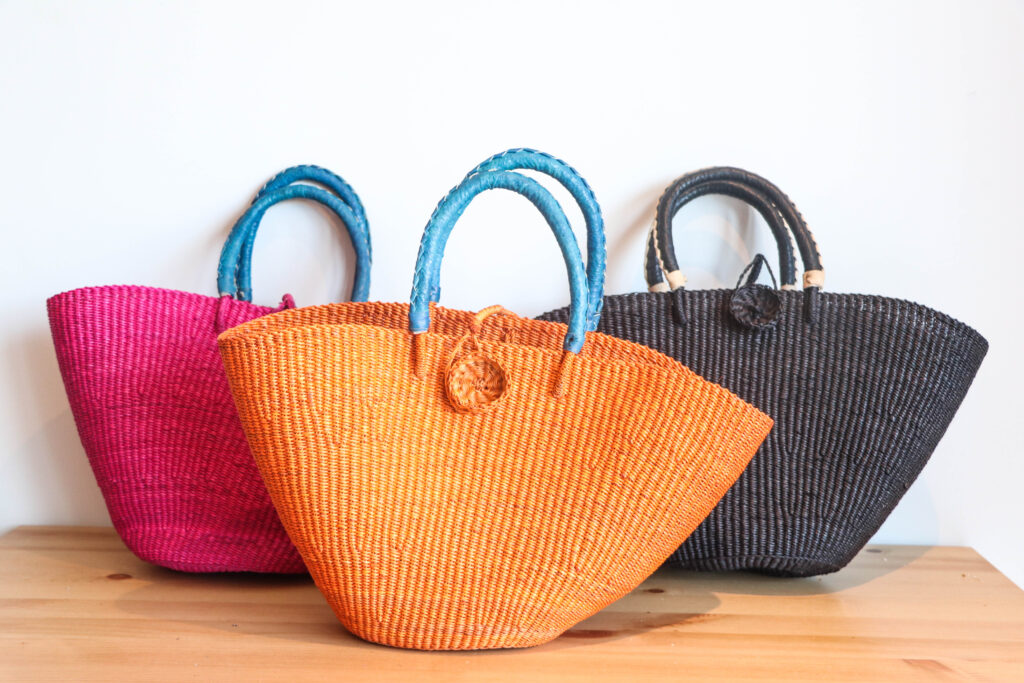
How a wild blade of grass growing in the fields of Northern Ghana becomes the beautiful, one-of-a-kind bag in your hands.
By the Asiesie Team · Handcraft & Heritage · 6 min read
Have you ever held something and thought — someone poured their soul into this? That’s exactly what happens every time a Ghanaian artisan picks up a strand of elephant grass and begins to weave. What starts as a humble blade of wild grass growing under the West African sun ends up as a vibrant, durable, and absolutely stunning bag. And the journey in between? It’s nothing short of magical.
At Asiesie, we are obsessed with this process. We think once you know the story behind your bag, you’ll never look at it the same way again. So let’s take you on a trip — from the fields of Ghana all the way to your front door.
It all starts with a blade of grass
Deep in the savannah of Northern Ghana, a wild grass called veta vera — known locally as kinkahe — stretches tall under the blazing sun. This is elephant grass, named because it grows so abundantly and so tall that elephants once roamed through it freely. For centuries, people looked at this grass and saw not a weed, but a raw material full of possibility.
Farmers carefully harvest the tops of the grass, cutting just enough to use while leaving the roots in the ground to grow back. It’s a beautifully sustainable system — one that has been practiced for generations without depleting the land.
“The grass is cut leaving the roots in the soil to regenerate — a practice passed down for generations that keeps the land and the craft alive at the same time.”
Once harvested, the grass is bundled, dried over several days in the open air, and then transported to the weavers of Bolgatanga — the craft heartland of Northern Ghana and the birthplace of the iconic Bolga basket.
The hands that transform everything
This is where the real artistry begins — and where it gets truly jaw-dropping.
The weavers of Bolgatanga, predominantly women from the indigenous Gurune (also known as Frafra) people, have been practicing this craft since childhood. It’s not something you learn from a YouTube tutorial. It’s something that is passed down from grandmother to mother to daughter over decades, embedded in muscle memory, in instinct, in cultural pride.
Let that sink in for a moment. Every single product is made entirely by hand, from start to finish, by a real person with a real name and a real story. No machines. No assembly lines. No shortcuts.
More than a bag — it’s a lifeline
Here’s something that makes owning one of these pieces even more meaningful. For many women in Northern Ghana, basket weaving isn’t a hobby — it’s how they feed their families. The soil in the Bolgatanga region is too poor for reliable farming, so for generations, weaving has been the economic backbone of these communities.
When you buy an Asiesie product, you are directly supporting a weaver and her family. You’re helping keep a centuries-old tradition alive. You’re choosing a product that is eco-friendly, biodegradable, and made with zero industrial waste. And you’re bringing a piece of living Ghanaian culture into your home.
Did you know?
Ghana exported roughly $800,000 worth of handwoven baskets to international markets in 2017 alone — with demand growing every year in the US, UK, Australia, Canada, and beyond. The world is waking up to what Ghana has always known: these are not just products. They are works of art.
Why we’re so proud to share this with you
At Asiesie, we didn’t just want to sell beautiful things. We wanted to share a story. The story of a people whose creativity turned wild grass into global treasure. The story of women who wake up every morning and pour skill, patience, and love into every knot they tie. The story of Ghana — vibrant, resourceful, and endlessly inspiring.
Every bag, basket, and accessory you find in our shop carries that story within it. The next time you carry yours, we hope you feel it — that quiet sense of connection to something real, something ancient, and something extraordinary.
That’s the Asiesie difference. Made in Ghana. Made for the world.
Ready to own a piece of this story?
Browse our full collection of handmade Ghanaian goods — each one crafted by skilled artisans in the heart of Ghana.
Shop the Collection →