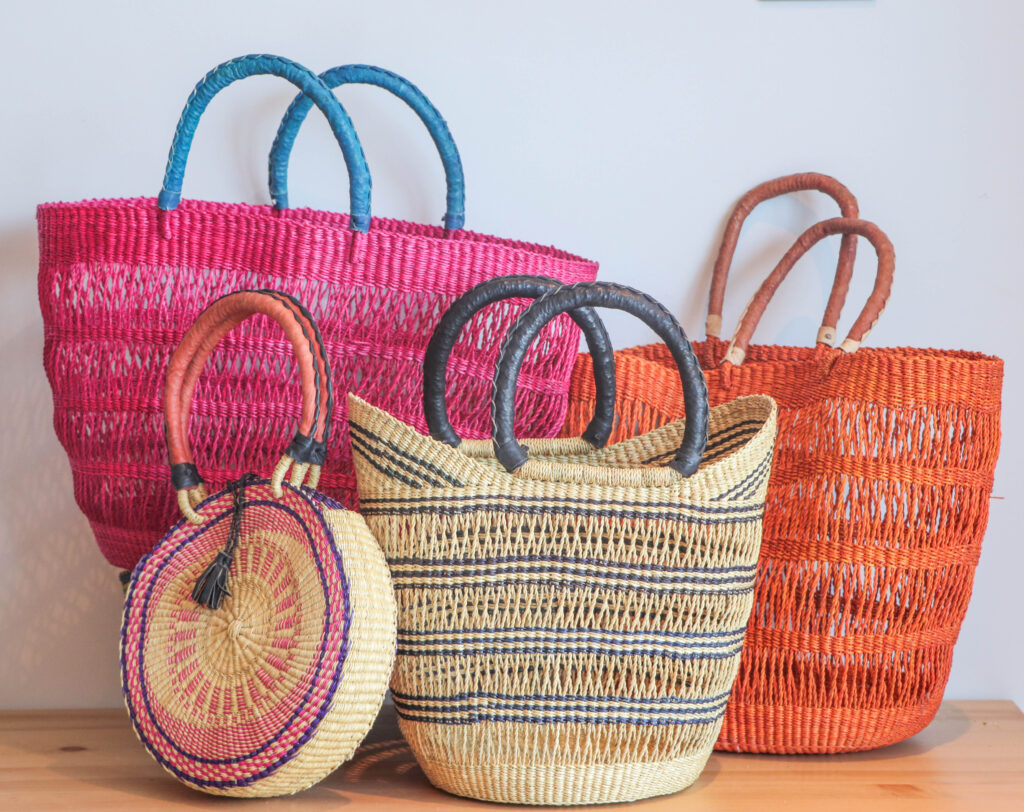
Every color, every weave, every knot tells a story that has been whispered across generations in Northern Ghana. Here’s how to read it.
When you hold an Asiesie bag, you are holding a conversation that has been going on for centuries. Not a conversation in words — but in colors, patterns, and symbols that the Gurune people of Northern Ghana have used to express identity, faith, community, and pride long before the rest of the world ever took notice.
Most people see a beautiful basket and think: what a gorgeous design. And they’re right. But there is so much more going on beneath the surface. Once you know what to look for, you’ll never look at a Ghanaian handmade piece the same way again.
Let us take you inside the language of the weave. 🇬🇭
First — a connection that will blow your mind
Did you know that the word Kente — Ghana’s world-famous woven cloth — literally comes from the Akan word “kenten,” meaning basket? That’s right. Kente cloth and basket weaving share the exact same roots. The interlacing of threads in Kente fabric mirrors the interlacing of grass in a Bolga basket. They are, at their core, the same ancient art form expressed in different materials.
“Ghanaian textiles are not just decoration — they are visual languages. Every color, pattern, and configuration carries meaning that speaks without words.”
This is why when you look at the geometric patterns on a Ghanaian basket, you are seeing the same visual philosophy that runs through Kente cloth, Adinkra symbols, and centuries of Akan artistic tradition. It is all one continuous story.
The language of color
In Ghana, color is never accidental. Every shade carries weight — cultural, spiritual, and emotional. The artisans of Bolgatanga choose their colors intentionally, drawing on a deep well of shared meaning that every Ghanaian understands instinctively.
Here is what the colors in your Asiesie piece may be saying:
So the next time you look at the bold pop of orange and black in one of our pieces, or the earthy mix of yellow and green — know that someone made a conscious, intentional choice about what those colors say. Your bag is not just styled. It is speaking.
The patterns — geometry with a soul
Beyond color, the geometric patterns woven into Ghanaian baskets and bags connect directly to Ghana’s rich tradition of Adinkra symbols — a collection of visual icons originating from the Akan people that have been used for centuries to express proverbs, values, and spiritual beliefs.
Think of Adinkra as West Africa’s original visual language — a system of symbols so rich and complete that they appear on royal cloth, architecture, jewelry, and yes, handwoven baskets. Here are some of the most beloved symbols and what they mean:
The most widely used Adinkra symbol in Ghana. It expresses the supremacy of God — “I fear no one except God.” A declaration of faith and humility.
Depicted as a bird looking backward. It means: never be afraid to go back and learn from the past. One of Ghana’s most powerful cultural concepts.
A symbol of divine protection and presence. It represents the place where God dwells — offering shelter, safety, and spiritual grounding.
Two crocodiles sharing one stomach. A symbol of democracy and community — even those who compete must cooperate to survive. Deeply woven into Northern Ghanaian life.
The fern plant, which thrives in difficult conditions. It represents endurance, resourcefulness, and the ability to survive and thrive against all odds.
Represents humility and strength. Even the strongest ram bows its head. A reminder that true power walks hand in hand with humility.
✨ A beautiful connection
Adinkra symbols have transcended their Akan origins and now appear on Ghanaian logos, architecture, clothing, and everyday objects around the world. They are, as one scholar beautifully put it, “visual proverbs that whisper timeless truths” — and they are woven into the very DNA of every piece crafted in Ghana.
Every piece is a one-of-a-kind story
Here is something truly special about every Asiesie product: no two are exactly alike. Each artisan brings their own personality, community identity, and personal symbolism to what they create. The patterns they choose, the colors they combine, the subtle variations in the weave — these are all the fingerprint of a real human being with a real story.
Some weavers incorporate patterns that have been in their family for generations — passed from grandmother to mother to daughter like a secret language only they fully understand. Others experiment with new color combinations while still honoring the traditional structure. The result is always something that sits beautifully between ancient and alive.
Did you know?
Adinkra symbols are so deeply embedded in Ghanaian culture that Ghana’s president John Mahama wore Kente cloth featuring Adinkra motifs at his 2025 inauguration — an act recognized nationally as a powerful statement of cultural identity and unity. These are not relics of the past. They are living, breathing symbols that shape Ghanaian identity every single day.
What this means when you carry Asiesie
When you carry one of our bags, you are not just making a fashion choice. You are carrying a piece of a visual language that has survived colonization, globalization, and centuries of change — and come out the other side more vibrant than ever.
You are carrying the gold of Ghanaian royalty, the green of fertile Northern soil, the geometric wisdom of Adinkra symbols, and the personal touch of an artisan who poured hours, skill, and heritage into every single knot.
That is what makes Asiesie different. That is why we say — proudly, loudly, always — Made in Ghana. Made for the world.
Carry the story with you.
Browse our full collection of handmade Ghanaian goods and find the piece that speaks to you.
Shop the Collection →